
|


|
Dates and Locations:
 University of Wisconsin
Fluno Executive Education Center
Madison, Wisconsin USA
June 23-25, 2010
Located in the heart of downtown Madison and in the center of campus, the center is easy to locate, at 601 University Avenue, between Lake and Frances Streets, and only 20 minutes from the Dane County Regional Airport.
Maps:
http://exed.wisc.edu/fluno/1location.htm
Who should attend:
This intermediate to advanced course is designed for ground water scientists and engineers, project managers, compliance managers in the private, public and regulatory sectors. An fundamental understanding of ground water movement and bedrock stratigraphy are considered as a prerequisite for this course. It will focus on recently developed concepts and technology.
Continuing Education Information:
- 2.4 Continuing Education Units (CEUs)
(24.0 Professional Development Hours)
- Pre-approved for: Massachusetts LSP (LSP Course No. 1204), Connecticut LEP (LEP Course No. 100), Texas CAPM, Iowa DNR Certified Ground Water Professionals, & Oklahoma UST Consultants
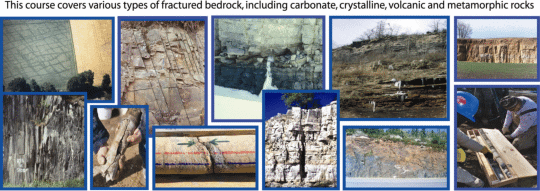
Introduction:
We have weaved new field methods that promote efficiency into this popular 3-day course. This year, the new course location allows access to a superb field site to master methods to increase efficiencies such as flow meters and televiewers. Numerical modeling advances are continuing too. Ground water, solute transport and fracture simulation modeling is capable of more while becoming easier to use.
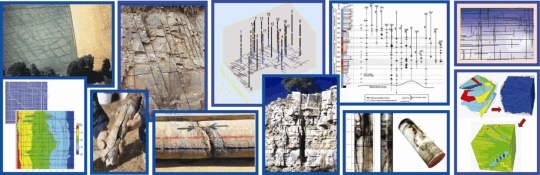
Enhance your efficiency, improve your expertise and gain a competitive advantage by mastering hydrogeologic testing, analysis and modeling fractured bedrock, including carbonate, crystalline, and metamorphic rocks.
Day One begins with the principles of hydrogeologic site characterization, groundwater movement and contaminant transport. It unravels the complexities of fractured systems and presents new trends in fracture characterization methods. Compare different advances in field characterization approaches, aquifer testing, rock core logging procedures, and building conceptual models for groundwater modeling.
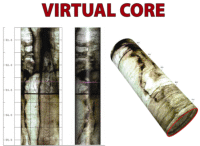
Day Two offers new field workshops for all experience levels. This year’s course location allows access to a new field location and exercises that include downhole flow meters, televiewers and packer testing. Come to the course and learn how to operate the equipment followed by analyzing and reporting the data.
Day Three continues with solute transport principles for both porous media and fractured bedrock. Learn about newly developed approaches, equipment and software for designing groundwater monitoring systems and remediation systems in fractured systems. Recent advances and efficiencies in ground water modeling and fracture modeling will be featured during this special course location at the University of Wisconsin, Madison.
This three-day workshop updates procedures for modern, state of the art, hydrogeologic analysis of fractured bedrock systems. It will include the following topics:
- Nature of Rock discontinuities and fracture flow
- Field-proven techniques for measuring and describing fracture networks
- Integrating rock stratigraphy into conceptual models
- Hands-on description of various rock cores
- Measurements of core recovery and RQD
- Dual porosity and discrete fracture conceptual models
- Equivalent porous media approximations and their validity
- Theory of ground water movement through discrete fractures
- Solute transport through fractures and fracture sets
- Single well and packer tests
- Packer tests and analysis strategies in fractured systems
- Application of surface and borehole geophysics, including dynamic flow meter tests
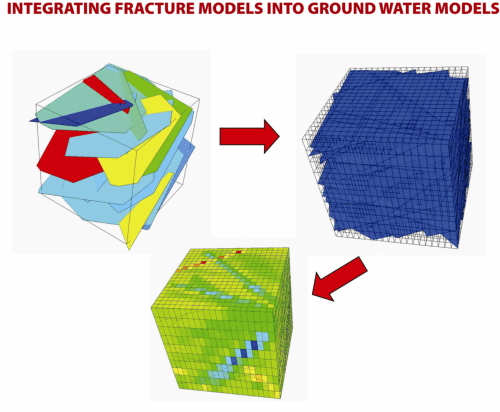
- Flow and transport modeling of fractured systems
- Discussion of problems submitted by participants
- Remediation techniques in fractured aquifers
This course begins with a brief overview of hydrogeologic principles for fractured bedrock and continues at an advanced level throughout the course to match the range of conditions typically encountered during field investigations.
Morning and Afternoon Classroom Sessions and Exercises (Wednesday)
The first day consists of real-world applications for evaluating the role of bedrock fractures in ground-water movement and contaminant transport. Special attention will be given to the inherent difficulties of ground water modeling in fractured bedrock systems. Listed below are some of the classroom sessions that will be included during Day One:
Hydrogeologic Settings for Fractured Rock:
- Differences between porous and fracture flow
- Rock types where fractures are important
- Formation of fractures
- Scale issues
- Fractures in regional ground water flow
- Problems with monitoring in fractured rock environments
Physical Characteristics of Fractures and Fracture Sets:
- Identification of fracture sets
- Statistical measures (frequency, orientation, length)
- Polar plots
- Connectivity
- Outcrop analysis
Aquifer Characterization in the Field:
- Surface geophysics
- Borehole geophysics
- Borehole flow meter
- Temperature/conductivity logging
- Geochemcial and isotopic applications
 Conceptual Models of Fluid Flow in Fractured Media:
- Fundamental equations of flow
- Hydraulic aspects of fractures
- Theory of flow through discrete fractures
- Dual porosity models
- Single fracture models
Packer Tests and Analyses:
- Packer tests
- Field techniques: Important considerations and common mistakes
- Methods of analysis
- Examples
Remediation Considerations and Strategies:
- Project goals and cost benefit analysis
- Time analysis and scale issues
Comparative Analysis of Remediation Systems:
- LNAPL transport and capture strategies
- DNAPL behavior and remediation history
- Chemical and thermal remediation methods
- Pump and treat remedial consideration in fractured bedrock
- Various pump and treat systems
- Recent considerations of remedial design in granite bedrock
- Do's and Don'ts when monitoring natural attenuation
- Effectiveness of natural attenuation
EXERCISE 1: Description of Rock Material / Core Characteristics
The first exercises during Day Two will begin with hands-on exercises that follow course concepts that are presented during the earlier classroom sessions. We will be using various types of NX rock core for several exercises including:
- This session will include a field inspection of various NX and HQ rock cores and a series of observational exercises for understanding stratigraphy, weathering sequences, and the distribution of fractures.
- Practice rock core descriptions on various rock types, measure rock core recovery, estimate RQD, and characterize fractures and stratigraphy.
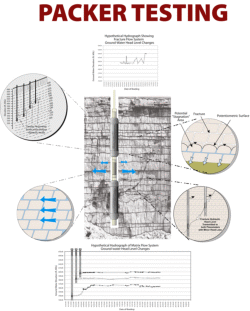
EXERCISE 2: Packer Testing and Data Analysis
Learn how to conduct packer testing and field-analyze for measuring Transmissivity and head across in the test interval.
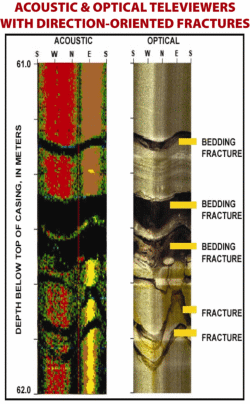
 EXERCISE 3: Flow Meters and Televiewers
Learn how to use flow meter logging tools in pre-drilled borings in the Prairie du Chien dolomite and identify fracture flow.
 EXERCISE 4: Fracture Recognition and Scanlines
Practice fracture recognition and apply it to assessing fracture trends and predicting subsurface fracture zones.
Classroom Sessions (Friday)
The third day includes a comprehensive comparison of different techniques for designing ground water models and remediation systems in fractured systems. Classroom sessions during the third day will include:
Remediation Exercises:
- LNAPL transport exercise
- LNAPL remediation exercise
- DNAPL characterization and remediation strategy exercise
Solute Transport Through Fractured Bedrock:
- Transport characteristics
- Analytical solutions
- Dispersion, dilution, sorption
- Non-aqueous phase contaminants
Numerical Models of Fracture Flow:
- Porous medial equivalent models
- Fracture network models
- Dual porosity models
- Stochastic models
- Applicability of models
- Available modeling codes
- Examples
Demonstration of Ground Water Flow Models:
- MODFLOW applications
- FRACMAN / MAFIC

Ground Water Monitoring in Fractured Rock:
- Overview of challenges
- Temporal variations
- Single-hole techniques
- Multi-level systems
- Examples
Tracer Studies:
- Types of tracers and tracer experiments
- Logistics of tracer studies
- Data collection
- Analysis of tracer studies
- Examples
Attendee Presentations:
Course participants are invited to bring hydrogeologic problem sets, hydrogeologic conceptual models, or rock core logs that you would like to present and discuss during the group review session at the end of the course (pre-session notice and review is necessary for scheduling purposes). Marketing presentations and corporate service promotions are not allowed).
Course adjourns at 5:00pm.
Registration Information:
Advanced registration is necessary for participation in this limited-enrollment short course. Pre-registration is required to reserve space and receive course materials. A minimum of 25 people must be registered at the early registration deadline to conduct any short course (this course normally reaches maximum capacity). Visitors will not be permitted to participate during the field workshops or enter the workshop areas. If you require special arrangements for diet, equipment, or handicap facilities, please indicate when registering for the course.
What you will receive:
You will receive 24.0 contact hours of instruction. The course includes a comprehensive 400-page workshop notebook containing written lessons and copies of the slides of each course segment, a Field Guide for Rock Core Logging and Fracture Analysis and a Field Guide for Slug Testing and Data Analysis. The course also includes morning coffee, lunch and afternoon break each day. A course completion certificate showing 2.4 Continuing Education Units (CEUs) will be administered for the course. Participants are welcome and encouraged to take photos during the field exercises.

FIELD GUIDE FOR ROCK CORE LOGGING AND FRACTURE ANALYSIS is included in your course registration.

FIELD GUIDE FOR SLUG TESTING AND DATA ANALYSIS is included in your course registration.
Cancellations:
Cancellations may be made up to two weeks before the course, however, 25 percent of the course fee will be charged. No refunds. One substitute is permitted for each registration who is unable to attend. Cancellations made after two weeks before the course will be charged $500.
Cost:
Register by June 10, 2010 - $1,195
Late Registration - $1,495.00
Student: Please inquire. 763.607.0092
- Maureen Muldoon, Ph.D., P.G.,
Assistant Professor, University of Wisconsin, Oshkosh, WI
- Kenneth Bradbury, Ph.D., P.G.,
Research Hydrogeologist, Wisconsin Geological and Natural History Survey, Madison, WI
- David J. Hart, Ph.D., P.G.,,
Research Hydrogeologist, Wisconsin Geological and Natural History Survey, Madison, WI
- Chris Mulry, P.G.,
Hydrogeologist, GES, Inc.
- Dan Kelleher, P.G., CIPM,
Hydrogeologist, Midwest GeoSciences Group
- I have taken a few Midwest Geosciences Group courses since 1997. They have all been of consistently high quality. (Midwest GeoSciences Group) are enthusiastic about sound science in the real world (consisting of) personable instructors whom are leaders in their fields and are excited about sharing their applied and practical research and experience. I recommend the Improving Hydrogeologic Analysis of Fractured Bedrock Systems course. The course provides a wealth of practical information to those who are new to the field and will likely cover some recent advances that are unfamiliar to experienced professionals as well.
- Eric Oelkers, P.G., Associate, Senior Hydrogeologist, BT Squared
- This is a highly practical course in fractured bedrock. I attended this course prior to beginning a large investigation at a site situated in a complex fractured rock setting. The course was an invaluable aid in planning the design of the components of the intrusive investigation and analysis of the field data. ...this is the most up-to-date and functional course that I have attended in years.
- S.C. Blauvelt, P.G., Vice President & Director of Regional Operations, Penn E&R, Inc.
- This was an excellent course with highly qualified instructors, up-to-date course material on fractured rock hydrogeology, and an outstanding field trip inside Yucca Mountain at the Nevada Test Site. I highly recommend (this course) to any geologists, environmental scientists, and engineers.
- Scott Shelton, City of Boston
- The course instructors had the right mix of theoretical expertise, practical experience, and enthusiasm. Also, the course instructors facilitated great interaction among the attendees which was an unexpected benefit of this course. It was well balanced and in-depth educational experience that was well worth my time and expense. It validated some of my own applications of fractured rock theory to LNAPLs, and gave me a better understanding with new tools to move forward in this area of hydrogeology.
- Don Lundy, ESNT, Inc.
- This course is an excellent overview of fracture flow coupled with new concepts of contaminant and fluid flow in fractured media. Not only does the course explain porosity & permeability of fractured settings, but it presents useful modeling approaches for fractured scenarios too. The instructors are terrific and highly knowledgeable in their field of study. The field trip to Yucca Mountain was the highlight of the course. I would recommend this course to anyone working with groundwater, ranging from contaminant assessments to water supply.
- Christine Bucklin, California Department of Toxic Substances Control
- A fantastic mix of knowledgeable and enthusiastic instructors, up-to-date and expansive course materials, and one spectacular field trip made this by far the best course I have attended.
- Kathleen T. Soukup, Weston Solutions, Inc.
- The course was excellent because of the combined classroom material and core logging - I can apply the course material immediately.
- Jami Poor, Kerr-McGee Corporation
- The combination and cohesiveness of the classroom, core logging practice, and Yucca Mountain field trip makes this a first rate and unique course.
- John Dougherty, CDM, Inc.
- The course "Improving Hydrogeologic Analysis of Fractured Bedrock Systems" was one of the most useful courses that I have taking in over 19 years in the environmental field. The course presented both the challenges associated with characterization of these complex hydrogeologic environments and the tools developed to address these complexities. The course is invaluable, in that, it condensed the multitude of work completed and currently being done at numerous fractured bedrock sites into a four-day course.
- Thomas M. Seckington, P.G., California Environmental Protection Agency Department of Toxic Substances Control
University of Wisconsin – The Fluno Executive Education Center
601 University Avenue,
Madison, WI 53715
Telephone (608) 441-7149/
Fax (608) 441-7133
http://exed.wisc.edu/fluno/3reservationreq.htm
$144.00/night
Mention Midwest GeoSciences Group to access guestroom block while it lasts.
Located in the heart of downtown Madison and in the center of campus, the center is easy to locate, at 601 University Avenue, between Lake and Frances Streets, and only 20 minutes from the Dane County Regional Airport.
This ideal location puts visitors only minutes away from the Wisconsin State Capitol, UW Memorial Union and State Street’s pedestrian mall featuring entertainment, a variety of bookstores, ethnic restaurants, coffeehouses, pubs and specialty shops. Also nearby are five museums, theater and performing arts, and UW Badger sporting events at the Kohl Center and Camp Randall Stadium.
Parking
The center is easy to locate, at 601 University Avenue, between Lake and Frances Streets. A 290-stall parking facility is conveniently located beneath the Fluno Center. The University of Wisconsin managed garage is available to the public for $10.00 per day or $6.00 per half-day. Additional public parking facilities within walking distance to the Fluno Center are indicated on the map below. If you have any questions about parking, please do not hesitate to contact the Fluno Center at 877-77-FLUNO or direct at 608-441-7117 for assistance.
http://exed.wisc.edu/fluno/1parking.htm
Travel Information
http://exed.wisc.edu/fluno/2travelinfo.htm
University of Wisconsin Website
http://www.wisc.edu/
Fluno Center for Executive Education
http://exed.wisc.edu/fluno/default.asp
Accommodations at the Fluno Center
http://exed.wisc.edu/fluno/2accommodations.htm
Parking at the Fluno Center
http://exed.wisc.edu/fluno/1parking.htm
Attractions on campus and off campus
http://exed.wisc.edu/fluno/1attractions.htm
Campus Map
http://www.vip.wisc.edu/map.html
Other On Campus Accommodations
http://www.vip.wisc.edu/lodging.html
Off Campus Accommodations
http://www.visitmadison.com/visitors/stay/
|
|
Become A Member
It's Free, It's Easy and as a
Member you'll enjoy...
- Exclusive Videos
- Special Pricing
- And Much More
|
|
Join
|
Learn More
|
Association of Environmental
& Engineering Geologists
|


