On-Demand Webinars
ARSENIC IN THE SUBSURFACE:
Differentiating Contamination from Naturally-Occurring Arsenic By Designing an Effective Site Investigation
Investigations of arsenic in groundwater often involve a large degree of spatial variability in solid-phase and aqueous arsenic concentrations and biogeochemical conditions that require careful data collection and interpretation. This webinar will review the fundamentals of arsenic geochemistry, methods for effective characterization of arsenic impacted sites, and practical tools for data interpretation.
This webinar is designed for professionals working in the fields of environmental consulting, site remediation, groundwater investigations, water quality issues, and brown fields developments. Regulators, consultants, engineers and hydrogeologists will appreciate the discussion of real-world examples and interpretations of familiar types of data and basic geochemical principles.
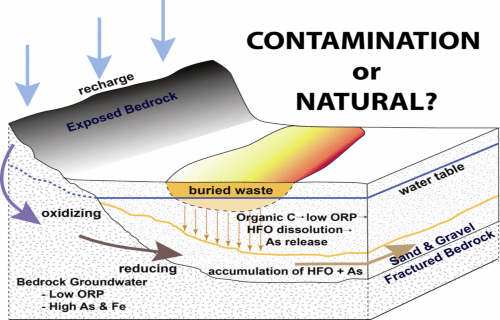
TOPICS:
- Approaches to characterize background and site conditions for arsenic investigations
- Case studies illustrating the use of common water chemistry data to identify sources of arsenic to groundwater
YOU WILL BENEFIT FROM THIS WEBINAR BY:
- Learning a step-wise process to identify important sources of arsenic and geochemical processes at a site
- Understanding concepts of arsenic mobility and transport supported by data sets and interpretation from case studies
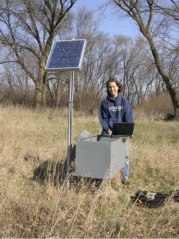 Madeline Gotkowitz Madeline Gotkowitz
Hydrogeologist, Wisconsin Geological and Natural History Survey
Professor, University of Wisconsin – Extension
Madeline Gotkowitz is a research scientist at the Wisconsin Geological and Natural History Survey, where her work focuses on regional groundwater flow and transport modeling, subsurface fate and transport of human enteric viruses, and flow and transport across aquitards. Gotkowitz's field-based investigations of arsenic in groundwater address conditions in surficial and bedrock aquifers, and the affect of well disinfection on arsenic release. Gotkowitz holds a B.A. in Environmental Sciences from Smith College and an M.S. in Hydrology from New Mexico Institute of Mining and Technology.
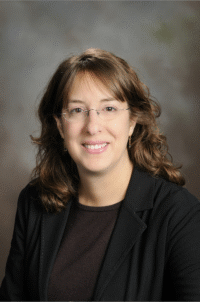 Madeline Schreiber Madeline Schreiber
Associate Professor, Geosciences
Virginia Tech University
Madeline Schreiber's research in chemical hydrogeology involves analysis and quantification of chemical and biological processes that impact contaminant transport. Over the past 10 years, Schreiber and her students have focused on biotransformation of both organic and inorganic species by subsurface microorganisms, adsorption of arsenic species (organic and inorganic) to subsurface materials, and release of trace elements from minerals during oxidative and reductive dissolution. Her work has been funded by the National Science Foundation, the U.S. Department of Agriculture, the National Institutes for Water Research, and private foundations. Schreiber received PhD and MS degrees from the University of Wisconsin-Madison and a BS degree from Yale University.
| Fee: |
299.00 USD Per Webinar
|
| Materials and Downloads: |
Session Slides (PDF)
Additional MaterialsRecord of Attendance Form (PDF)
|
Number of
Participants: |
As of June 1, 2020, online training is designed and priced for individuals working alone.
|
Continuing
Education
Certificates: |
$14.95 each. Official CEU certificates are available as an option. After successful completion of this webinar, a link will be provided to order a certificate from Northern Illinois University.
|
| Access: |
On-demand, anytime 24/7. |
| Discounts: |
Buy 3 on-demand webinars, and get 3 on-demand webinars for free!
|
| Duration: |
90 minutes |
| PDH Earned: |
1.5 hours |
| |
|
| Instructor(s): |
Madeline Gotkowitz, PG. and Madeline Schreiber, PhD. |
This On-Demand Webinar is NO LONGER available for purchase.
|
Become A Member
It's Free, It's Easy and as a
Member you'll enjoy...
- Exclusive Videos
- Special Pricing
- And Much More
|
|
Join
|
Learn More
|
Association of Environmental
& Engineering Geologists
|


