
EVALUATING THE SIGNIFICANCE OF MATRIX DIFFUSION IN FRACTURED ROCK:
Implications for the Fate, Transport, and Remediation of Groundwater Contaminants
Fractured rock aquifers are complex, differing significantly in lithology (igneous, metamorphic, sedimentary or karst) and on site-specific characteristics dictated by geologic history. This webinar offers an overview of chemical transport processes in fractured rock aquifers.
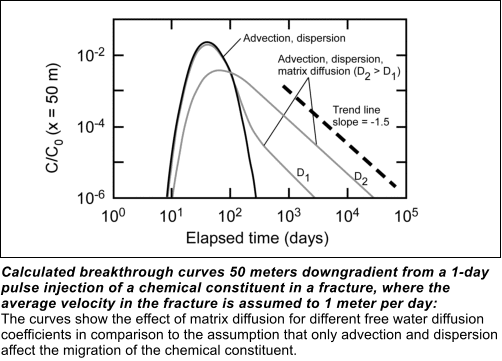
Groundwater movement in fractured rock aquifers is primarily through the fractures, of course, but chemical transport is also importantly related to diffusion between the fractures and the rock matrix. Diffusion can be to or from the rock matrix depending on the direction of the chemical gradient.
Relationship of Matrix Diffusion to Remediation
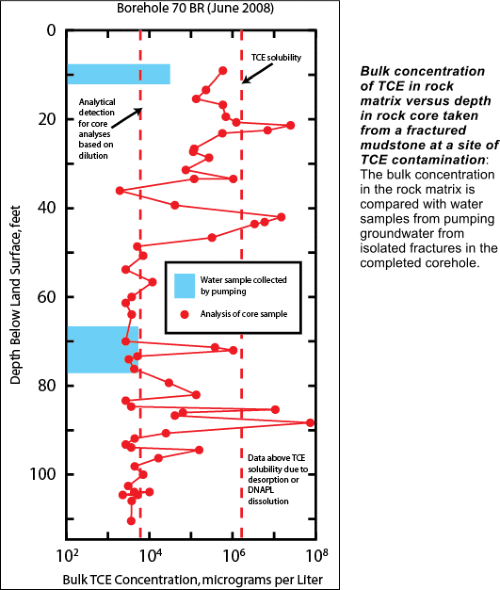
Participants will discover the importance of diffusion into and out of the rock matrix affecting the contaminant distribution and contaminant residence times. For remediation, diffusion into and out of the rock matrix affects the time frame of remediation, its cost, and likelihood of achieving project objectives. It is not uncommon to experience persistent contamination at fractured rock sites even after long-term pumping.
This special webinar will present how the role of matrix diffusion is a critical component of the characterization, monitoring, and remedial operations at sites of groundwater contamination. Participants will learn the critical parameters that control the magnitude of matrix diffusion and the significance of matrix diffusion is critical in the design and implementation of commonly used remediation technologies.
Highlights of the webinar include discussions of...
- the complexities associated with the lithology of fractured rock aquifers, including igneous, metamorphic, sedimentary and karst aquifers
- an overview of chemical transport processes in fractured rock with emphasis on the role of matrix diffusion in the distribution of contaminants
- characterization and monitoring in fractured rock aquifers to identify the magnitude and extent of contamination
- remediation technology applied to contaminated groundwater in fractured rock aquifers
Participants will technically benefit from this webinar by...
- recognizing the significance of matrix diffusion in designing site characterization and monitoring protocols in fractured rock aquifers
- recognizing the limitations of remediation technologies in their application to fractured rock aquifers
- introducing methods of sampling and analysis used to characterize the chemical concentrations in the rock matrix
- providing participants with summaries of key tools, articles, and additional resources that are pertinent to the interpretation of chemical transport and matrix diffusion in fractured rock aquifers
| Fee: |
299.00 USD Per Computer Site (unlimited participants per site)
Pay one site registration fee and an unlimited number of participants from your organization can attend at that site.
|
| Instructor: |
Allen Shapiro, PhD |
| Handouts: |
Copy of Webinar Slides (pdf)
Record of Attendance Form (pdf)
|
| Duration: |
1.5 hours plus Q&A
(no restrictions on time limit for extra Q&A!)
|
Professional
Development: |
Earn 1.5 Professional Development Hours (1.5 PDH)
 |
A Record of Attendance Form is included free with each webinar for your record keeping and individual PDH verification. We ask your on-site coordinator to return the completed and signed copy of the Form to us following the webinar for (1) maintaining a separate copy as a service to attendees and (2) forwarding to NIU confirming attendance for those who order certificates.
Attendees may also order an official a Course Completion Certificate from Northern Illinois University for a small administrative fee. The Certificate is optional and may be ordered separately following the webinar to confirm your attendance and showcase the certificate on your office wall. Instructions for ordering certificates are given during the webinar.

* This webinar is eligible for the 'BUY THREE, GET THREE' discount.
Attendees will be invited to actively participate during this live and interactive on-line web seminar. Discussion is planned following the webinar for those who want to continue the session. Bring your questions to the webinar and present them to the instructor and other participants for exploring the best solution.
Instructor Bios
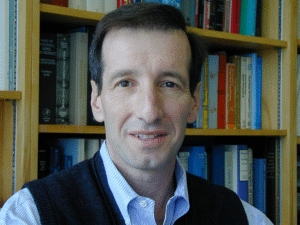 Allen M. Shapiro, Ph.D.
U.S. Geological Survey
Dr. Allen Shapiro has authored numerous papers on field investigations in karst and various types of fractured rock aquifers, as well as being active in the development of methods of quantifying properties that govern groundwater flow and chemical transport in fractured rock aquifers. Dr. Shapiro has also patented equipment used to conduct aquifer tests and monitor groundwater chemistry in fractured rock.
Dr. Shapiro is a Senior Research Hydrologist with the National Research Program (NRP) of the U.S. Geological Survey (USGS). His research has focused on the development of field techniques and equipment, and methods of integrating and interpreting geologic, geophysical, hydraulic, and geochemical information in the characterization of fractured rock aquifers. Dr. Shapiro has described fundamental processes of ground water flow and chemical transport that are unique to geologic environments characterized by significant heterogeneity. He has also investigated the effect of scale on the hydraulic and transport properties of fractured rock through carefully designed field testing and modeling investigations conducted over physical dimensions of meters to kilometers. Dr. Shapiro is currently active in the characterization and remediation of various contaminants in fractured rock, including groundwater contamination by Dense Non-Aqueous Phase Liquids (DNAPLs).
Dr. Shapiro was the 2004 National Ground Water Association (NGWA) Distinguished Darcy Lecture and is an associate editor of the journal Ground Water, and he holds a Ph.D. from Princeton University in Civil and Geological Engineering.
 Questions? Email us at service@midwestgeo.com or call 763.607.0092
Webinar Topic Suggestion: Click Here


