LNAPL TRANSMISSIVITY AS A METRIC:
The Future in Tracking LNAPL Recovery Progress
This 90-minute webinar will provide practitioners with an advanced understanding LNAPL transmissivity and a discussion of the physical and chemical conditions that affect LNAPL thickness and why it can be misleading for determining its occurrence and movement.
The rate at which a volume of LNAPL will flow through a unit width of porous material for a unit gradient is termed LNAPL transmissivity. It is possible to measure LNAPL transmissivity through several methodologies (for example, baildown tests, recovery data, soil core and tracer test analyses), but no consensus exists yet on standard methodologies.
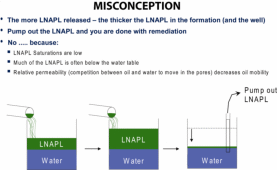
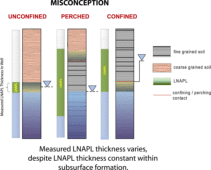
Comprehensive analysis of various sites will illustrate practical ways to consider LNAPL transmissivity and why it’s a meaningful metric.
Some webinar topics include:
- Review and elaborate on confined and perched LNAPL conditions
- Confined and Perched LNAPL conditions are likely the rule - not the exception
- LNAPL thickness in wells - while it is need to know info - why it is USELESS as an LNAPL metric
- What is LNAPL transmissivity
- How can you measure LNAPL transmissivity
- Why is LNAPL transmissivity a good metric
- Who is using LNAPL transmissivity and what are the initial thoughts
Meaningful methodologies to evaluate LNAPL transmissivity have been dramatically improved in recent years. The webinar instructors are leaders in development of LNAPL transmissivity as a metric for LNAPL recovery through their project work and developing ITRC LNAPL Guidance and ASTM for LNAPL Transmissivity. This is the first webinar session given collectively by this special team of practitioners.
Attendees are invited to actively participate during this live and interactive on-line web seminar. Discussion is planned following the webinar for those who want to continue the session. Bring your questions to the webinar and present them to the instructor and other participants for exploring the best solution.
| Fee: |
299.00 USD Per Computer Site (unlimited participants per site).
|
| Instructors: |
Mark Adamski, PG; Technical Specialist at BP America
Paul Cho, P.G.
Andrew Kirkman, PE
|
Pay one site (one computer) registration fee and an unlimited number of participants from your organization can attend at that site.
Participants will receive a handout referencing the webinar topics and discussion.
Earn 1.5 Professional Development Hour (1.5 PDH) is available for each verified attendee and receive a Course Completion Certificate from Northern Illinois University.
Attendees will be invited to actively participate during this live and interactive on-line web seminar. Discussion is planned following the webinar for those who want to continue the session. Bring your questions to the webinar and present them to the instructor and other participants for exploring the best solution.
Instructor Bio
 Mark R. Adamski, PG is a Technical Specialist with BP America where he directs BP and API research in the occurrence and behaviour of LNAPL in the subsurface. He has conducted research on this topic for ten years within BP and conducted, analyzed, and modeled LNAPL distribution and recovery at BP sites worldwide. As a result of this experience he has presented at conferences, seminars, and workshops internationally for several years, including the Midwest GeoSciences Group. He has been involved with the development of landmark regulatory LNAPL guidance documents developed by the State of Texas, ITRC, and the US EPA. His primary areas of current LNAPL study are site characterization techniques, LNAPL metrics, plume migration, and recovery techniques. Mark has worked in modeling fluid migration in porous media throughout his 17 year career with BP. He holds a BS in Geological Engineering and a MS in Hydrogeology. Mark is currently located in the BP office at Westlake in Houston, Texas.
 Paul Cho, P.G.
Paul is working at the State of California Regional Water Quality Control Board, Los Angeles Region since 1989 after his MS degree in Geology from the University of Southern California. His regulatory work experience involves solid waste disposal facilities construction, closure and environmental programs, and environmental enforcement for oil refineries. Paul has been involved with the Solid Waste Assessment Test Program management, RCRA EI Program with the US EPA and Los Angeles LNAPL Project with the Western States Petroleum Association.
 Andrew Kirkman, PE
Mr. Kirkman has 11 years experience conducting environmental investigations and engineering. Mr. Kirkman specializes in subsurface petroleum hydrocarbon, coal tar and creosote distribution, release and recovery studies. He has characterized the distribution and mobility of NAPL at multiple refinery, railroad, retail, manufactured gas plant, wood treating and terminal sites. Mr. Kirkman has worked with regulatory agencies across the nation to accept alternative metrics to NAPL remediation such as NAPL transmissivity or recoverability rather than gauged NAPL thickness alone. Mr. Kirkman has presented technical discussions regarding the use of NAPL transmissivity, petroleum baildown tests, core analyses and laser induced fluorescence technology at multiple conferences. He eagerly promotes the discussion of improved LNAPL understanding through LNAPL forums such as the Interstate Regulatory Council publications and as the chair of an ASTM task group under E50.04 to develop a guidance document on the calculation of LNAPL Transmissivity.


