
| Friday, December 10, 2010
|

|
ROCK CORE LOGGING FOR HYDROGEOLOGIC PROJECTS:
Assessing Recovery, RQD, Fractures and Stratigraphy
This 90-minute webinar is designed to demystify the confusion associated with measuring rock core recovery and RQD while characterizing stratigraphy and fractures in rock cores.
Confusing methods, conflicting terms, and variations of published techniques have caused professionals to log core inconsistently and sometimes, incorrectly. The contrasting differences between geotechnical applications and hydrogeologic purposes have also contributed to different logging styles and methods that have resulted in insufficient information for hydrogeologic projects.
Learn to log and describe rock core in order to take the mystery out of the subsurface.
We have assembled many of the geographic differences in rock coring terms and designed a webinar that presents these common difficulties along with methods that helps take the mystery out of the subsurface.
This webinar will cover the following topics:
- Measuring core recovery and Rock Quality Determination (RQD)
- Identifying natural core breaks from drilling breaks
- Identifying the importance and application of water loss during coring and drilling
- Photographing rock core and placing and labeling rock cores in the box
- Describing rock cores of various rock types
- Giving context to rock cores by building the litho- and hydrostratigraphic framework
- Assessing fracture networks from rock cores and understanding the story that rock cores are telling
Geologic context is key for success with logging both sediments and rock. In this webinar, we will also present up-to-date procedures for building the hydrogeologic framework during the field activities and their importance and benefits.
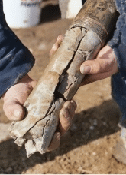
Characterizing fractures is good, but understanding their context and distribution is a key for confident characterization. This webinar presents the common elements for providing that context.
PLUS! We will present a 15-minute summary of useful downhole tools and their recent updates. Flow meter technology, high-resolution temperature distribution using fiber optics, and both acoustic and optical televiewers are advancing and becoming easier to use from year to year. Discover how to use these modern technologies and choose what is best for your projects
| Schedule: |
Friday, 10 December 2010
11am (Pacific)
12 noon (Mountain)
1pm (Central)
2pm (Eastern)
Click Here for World Clock http://www.timeanddate.com/worldclock
|
| Fee: |
299.00 USD Per Computer Site (unlimited participants per site).
|
| Instructors: |
Ken Bradbury, Ph.D., PG, Program Leader and Hydrogeologist at the Wisconsin Geological Natural History Survey and
Dan Kelleher, PG, CIPM, Author of the FIELD GUIDE FOR ROCK CORE LOGGING AND FRACTURE ANALYSIS
|
Pay one site registration fee and an unlimited number of participants from your organization can attend at that site.
Participants will receive a handout referencing the webinar topics and discussion.
Earn 1.5 Professional Development Hours (1.5 PDH) for this webinar.
A Record of Attendance Form is included free with each webinar for your record keeping and individual PDH verification. We ask your on-site coordinator to return the completed and signed copy of the Form to us following the webinar for (1) maintaining a separate copy as a service to attendees and (2) forwarding to NIU confirming attendance for those who order certificates.
Attendees may also order an official a Course Completion Certificate from Northern Illinois University for a small administrative fee. The Certificate is optional and may be ordered separately following the webinar to confirm your attendance and showcase the certificate on your office wall. Instructions for ordering certificates are given during the webinar.

* This webinar is eligible for the ’BUY THREE, GET THREE’ discount.
|
FREE
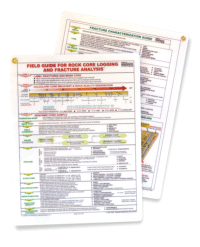
FIELD GUIDE FOR ROCK CORE LOGGING AND FRACTURE ANALYSIS
With each site registration.
|
"Help yourself to think on your feet in the field"
- Improve the accuracy of your rock core logs
- Reliably measure core recovery and RQD
- Prepare consistent descriptions
- Analyze rock as the drilling program progresses
- Quickly characterize fractures and their distribution
- Build the geologic framework from boring to boring
- Identify general rock types
- Obtain guidance for placing and labeling cores in the box
- Reduce log editing time
The FIELD GUIDE is a double-sided, plastic-coated guide for improving rock core descriptions and characterizing bedrock fractures on meaningful rock core logs that are clear, consistent, and concise.
PLUS: Register for this webinar and receive an appreciable discount on additional copies of the FIELD GUIDE FOR ROCK CORE LOGGING AND FRACTURE ANALYSIS for your whole project team. Discount only applies during time of webinar registration.
|
Attendees will be invited to actively participate during this live and interactive on-line web seminar. Discussion is planned following the webinar for those who want to continue the session. Bring your questions to the webinar and present them to the instructor and other participants for exploring the best solution.
Instructor Bio
Kenneth Bradbury, PhD, PG
 Dr. Kenneth Bradbury is Wisconsin's State Geologist and Director of the Wisconsin Geological and Natural History Survey, UW-Madison Division of Extension. Ken is a hydrogeologist who has worked and published on groundwater issues in Wisconsin since 1982, with a focus on applied problems. His research has included investigations of virus transport in groundwater, groundwater flow in fractured rocks, aquitard hydrogeology, groundwater recharge processes, wellhead protection, regional groundwater simulation, and the hydrogeology of glacial deposits.
He received his B.A. from Ohio Wesleyan University, where he majored in geology, then earned a Master's degree from Indiana University. He received his PhD from the UW-Madison Department of Geology in 1982.
Ken is an affiliate faculty member in the UW-Madison Department of Geoscience and the Nelson Institute at UW-Madison. He is a Fellow in the Geological Society of America and is active in the Association of American State Geologists. Ken has served on the Water Science and Technology Board of the National Academy of Sciences and on committees advising the US Geological Survey.
Dan Kelleher, PG, CIPM
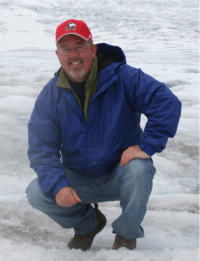 Dan Kelleher is a hydrogeologist who strives for excellence in subsurface characterization. Dan earned his bachelor’s degree from Monmouth College and master’s degree at Northern Illinois University. His technical expertise is quantitative hydrogeology (in porous and fractured media), geotechnical analysis of sedimentary sequences, aquifer testing and predictive ground water modeling. He promotes field analysis during stratigraphic characterization from boring to boring in order to utilize QA/QC processes fully throughout a project and help identify unexpected conditions as soon as they arise..
 Questions? Email us at service@midwestgeo.com or call 763.607.0092
Webinar Topic Suggestion: Click Here


